


August 15, 2026
Neurodiversity in the Workplace: A Practical Manager's Guide
A practical guide to neurodiversity in the workplace for managers, HR and school leaders: day-to-day management, adjustments that work, meetings, feedback and measuring impact.
Most organisations have a neurodiversity policy. Far fewer have managers who know what to do on a Monday morning when a team member cannot start a task, cannot sit in an open-plan office, or has gone quiet after a piece of feedback.
This guide is for the people who actually hold the relationship: line managers, HR business partners, and school leaders. It moves past policy language into the day-to-day practice that decides whether inclusion is real or decorative.
Start with the shift: accommodation to contribution
Policy-first thinking treats neurodivergence as a problem to be mitigated. Practice-first thinking treats it as a working style to be resourced. The 2026 direction of travel in the UK is clear, and we covered the evidence in our piece on the NIB report and neurodiversity gain.
The management version of that shift is one question, asked early and asked plainly: "What conditions do you do your best work in?" You are not diagnosing anyone. You are designing a job around a person who is already employed to do it.
The five things managers get wrong
- Waiting for disclosure. Most neurodivergent staff never disclose. Design for the whole team, not for the people brave enough to tell you.
- Offering adjustments, then changing nothing about the work. Noise-cancelling headphones do not fix a meeting culture that runs on unplanned verbal decisions.
- Treating a diagnosis as a support plan. Two people with the same diagnosis can need opposite things.
- Assuming poor performance is attitude. Task initiation, working memory and overwhelm look like disengagement from the outside.
- Making it a one-off training day. Awareness without a management routine decays in six weeks.
Day-to-day management practices that work
Meetings
- Send an agenda and the decision to be made, at least 24 hours ahead.
- Allow written contributions before and after. Fast verbal debate rewards one processing style.
- Record actions in writing, with owner and date, in the meeting itself.
- Default to cameras optional.
Instructions and tasks
- Give the outcome, the deadline and the definition of "done" together.
- Break big tasks into a first step small enough to start today.
- Confirm in writing after a verbal conversation. Not as a paper trail, as a memory aid.
- Say which parts are flexible and which are fixed.
Feedback
- Separate the work from the person, explicitly and out loud.
- Give feedback in a predictable rhythm, not as a surprise.
- Ask what format helps: written first, or spoken first with written follow-up.
- Rejection sensitivity is real. Lead with the specific, not the vague.
Environment
- Offer genuine choice over where focused work happens.
- Reduce sensory load where you can: lighting, noise, interruption norms.
- Provide a low-stimulus space people can use without asking permission. Our Peace Pods exist for exactly this in schools and workplaces.
Adjustments: the practical shortlist
| Need | Adjustment that usually works | Cost |
|---|---|---|
| Sensory overload | Quiet space, headphones, desk relocation, lighting change | Low |
| Task initiation | Written first step, body-doubling, shorter check-in cycles | None |
| Working memory | Written follow-ups, shared task board, recorded meetings | None |
| Time blindness | Buffered deadlines, calendar blocking, agreed reminders | None |
| Meeting overwhelm | Agenda ahead, written input, fewer attendees | None |
| Burnout recovery | Phased return, reduced meeting load, coaching support | Medium |
Most of what changes outcomes costs nothing. Where funding is needed, UK employees can often access Access to Work grant funding, which can cover coaching, equipment and support workers.
For school leaders
The same principles apply to staff, and then again to pupils. Two additions:
- Consistency across adults matters more than brilliance in one. A pupil who gets a regulated response from one teacher and a sanction from the next learns that adults are unpredictable.
- Regulation before instruction. A dysregulated nervous system cannot access teaching. Our schools CPD is built around that order, and neurodiversity training for teachers covers the classroom detail.
Build the manager routine
Inclusion holds when it is scheduled. A workable minimum:
- Onboarding: ask the working-conditions question in week one, for everyone.
- Weekly: a short one-to-one with a written summary.
- Quarterly: review whether the agreed adjustments are still right. Needs change.
- Annually: refresh manager training, and check whether your adjustment requests are being approved or quietly stalled.
Measure something
If you cannot measure it, it will be cut in the next budget round. Useful, low-effort measures:
- Retention and sickness absence, compared across teams.
- Time from adjustment request to adjustment in place.
- Proportion of managers who have completed training in the last 12 months.
- Anonymous pulse question: "I can do my best work here." Track the trend, not the number.
Where training fits
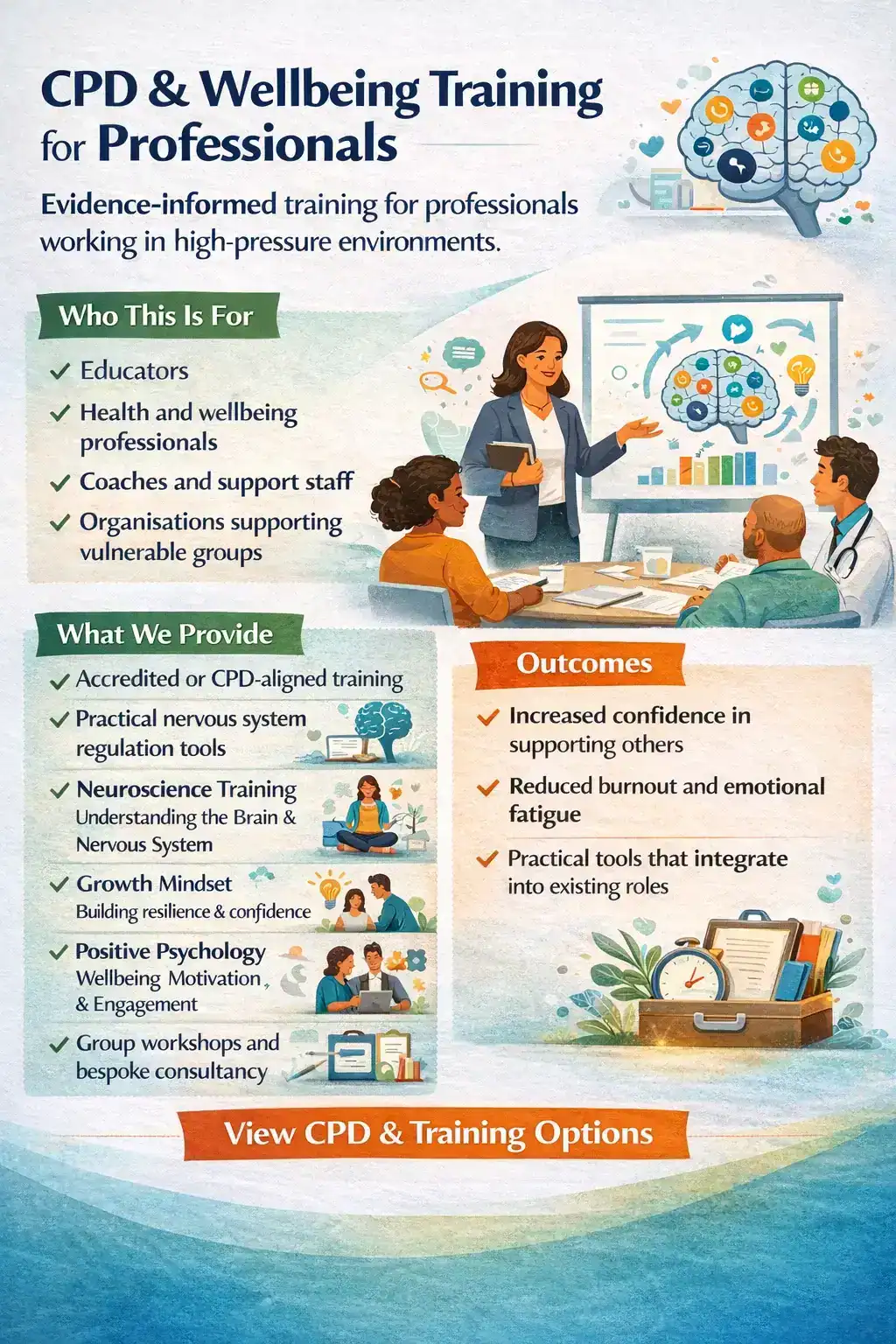
Managers need three things: the model, the scripts, and permission to act. Our workplace CPD training is CPD accredited and delivered by trainers with lived experience, covering nervous-system regulation, adjustment conversations, and manager scripts you can use the same week. For individual staff, ADHD coaching supports the person while the organisation changes around them.
Start here
Pick one thing from this guide and do it for a month across your whole team. Agendas ahead of meetings is the usual winner: it costs nothing, helps everyone, and requires no disclosure from anyone.
👉 Book a free discovery call to talk through manager training for your organisation, or see the full Find Your Inner Peace ecosystem.
Frequently asked questions
- What does neurodiversity in the workplace actually mean?
- It means recognising that brains process, focus, communicate and regulate differently, and designing work so that a range of those styles can perform well. In practice it covers ADHD, autism, dyslexia, dyspraxia, Tourette's and more, whether or not someone has a formal diagnosis.
- What are the most effective adjustments a manager can make?
- Written follow-ups after verbal conversations, agendas sent ahead of meetings, a clear first step on every task, genuine choice over where focused work happens, and a low-stimulus space available without permission. Most cost nothing.
- Do I need an employee to disclose before I make changes?
- No. Most neurodivergent staff never disclose. Universal design practices such as written summaries and agendas help the whole team and require no disclosure from anyone. Formal adjustments under the Equality Act 2010 do require the employer to know of the disability.
- Who pays for workplace adjustments in the UK?
- Employers are required to make reasonable adjustments under the Equality Act 2010. Where cost is a barrier, Access to Work grant funding can contribute towards equipment, coaching and support for eligible employees.
- How do we know whether neurodiversity training has worked?
- Track retention and absence by team, the time between an adjustment request and it being in place, the proportion of managers trained in the last 12 months, and the trend on an anonymous pulse question such as 'I can do my best work here'.
- Does this apply to schools as well as workplaces?
- Yes. The same principles apply to staff, and then again to pupils, with two additions: consistency across adults matters more than brilliance from one, and regulation must come before instruction.
Tags
Share this post
Copy the link to share on Instagram or TikTok.
Newsletter
Get new notes in your inbox.
Short, practical writing on brain training, coaching, and calmer work. No spam. Unsubscribe any time.
By subscribing you agree to our Privacy Policy.